Conversion between coordinate systems.
Examples
Example 6a.1
Find the cartesian coordinates of the point
![P = [r, theta, z]](images/Lesson_06a1.gif) =
=
![[3, Pi/6, 5]](images/Lesson_06a2.gif)
Substitute the cylindrical coordinates
![[r, theta, z] = [3, Pi/6, 5]](images/Lesson_06a3.gif) into the transformation formulas
into the transformation formulas


| > | P:={r=3, theta=Pi/6, z=5}; |
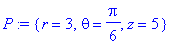
| > | ans[`6a.1`]:=[x,y,z]=simplify(subs(P, [r*cos(theta), r*sin(theta), z])); evalf(ans[`6a.1`]); |
![ans[`6a.1`] := [x, y, z] = [3/2*3^(1/2), 3/2, 5]](images/Lesson_06a8.gif)
![[x, y, z] = [2.598076212, 1.500000000, 5.]](images/Lesson_06a9.gif)
| > |
Example 6a.2
Find the cylindrical coordinates of the point
![P = [x, y, z]](images/Lesson_06a10.gif) =
=
![[1, 2, 3]](images/Lesson_06a11.gif) .
.
Substitute the cartesian coordinates
![[x, y, z] = [1, 2, 3]](images/Lesson_06a12.gif) into the transformation formulas
into the transformation formulas
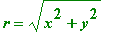


| > | P:={x=1, y=2, z=3}; |

| > | ans[`6a.2`]:=[r, theta, z]=simplify(subs(P, [sqrt(x^2+y^2), arctan(y,x), z])); evalf(ans[`6a.2`]); |
![ans[`6a.2`] := [r, theta, z] = [5^(1/2), arctan(2), 3]](images/Lesson_06a17.gif)
![[r, theta, z] = [2.236067977, 1.107148718, 3.]](images/Lesson_06a18.gif)
| > |
Example 6a.3
Find the cartesian coordinates of the point
![P = [rho, theta, phi]](images/Lesson_06a19.gif) =
=
![[4, Pi/6, Pi/4]](images/Lesson_06a20.gif) .
.
Substitute the spherical coordinates
![[rho, theta, phi] = [4, Pi/6, Pi/4]](images/Lesson_06a21.gif) into the transformation formulas
into the transformation formulas



| > | P:={rho=4, theta=Pi/6, phi=Pi/4}; |
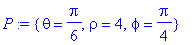
| > | ans[`6a.3`]:=[x,y,z]=combine(simplify(subs(P, [rho*cos(theta)*sin(phi), rho*sin(theta)*sin(phi), rho*cos(phi)])), radical); evalf(ans[`6a.3`]); |
![ans[`6a.3`] := [x, y, z] = [6^(1/2), 2^(1/2), 2*2^(1/2)]](images/Lesson_06a26.gif)
![[x, y, z] = [2.449489743, 1.414213562, 2.828427124]](images/Lesson_06a27.gif)
| > |
Example 6a.4
Find the spherical coordinates of the point
![P = [x, y, z]](images/Lesson_06a28.gif) =
=
![[1, 2, 3]](images/Lesson_06a29.gif) .
.
Substitute the cartesian coordinates
![[x, y, z] = [1, 2, 3]](images/Lesson_06a30.gif) into the transformation formulas
into the transformation formulas

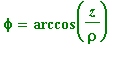 =
=
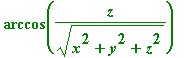
| > | P:={x=1, y=2, z=3}; |

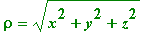
| > | ans[`6a.4`]:=[rho, theta, phi]=simplify(subs(P, [sqrt(x^2+y^2+z^2), arctan(y,x), arccos(z/sqrt(x^2+y^2+z^2))])); evalf(ans[`6a.4`]); |
![ans[`6a.4`] := [rho, theta, phi] = [14^(1/2), arctan(2), arccos(3/14*14^(1/2))]](images/Lesson_06a36.gif)
![[rho, theta, phi] = [3.741657387, 1.107148718, .6405223126]](images/Lesson_06a37.gif)
| > |
Example 6a.5
Find the cylindrical coordinates of the point
![P = [rho, theta, phi]](images/Lesson_06a38.gif) =
=
![[3, Pi/3, Pi/6]](images/Lesson_06a39.gif)
Substitute the spherical coordinates
![[rho, theta, phi] = [3, Pi/3, Pi/6]](images/Lesson_06a40.gif) into the transformation formulas
into the transformation formulas



| > | P:={rho=3, theta=Pi/3, phi=Pi/6}; |
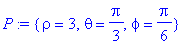
| > | ans[`6a.5`]:=[r, theta, z]=simplify(subs(P, [rho*sin(phi), theta, rho*cos(phi)])); evalf(ans[`6a.5`]); |
![ans[`6a.5`] := [r, theta, z] = [3/2, 1/3*Pi, 3/2*3^(1/2)]](images/Lesson_06a45.gif)
![[r, theta, z] = [1.500000000, 1.047197551, 2.598076212]](images/Lesson_06a46.gif)
| > |
Example 6a.6
Find the spherical coordinates of the point
![P = [r, theta, z]](images/Lesson_06a47.gif) =
=
![[2, Pi/4, 7]](images/Lesson_06a48.gif) .
.
Substitute the cylindrical coordinates
![[r, theta, z] = [2, Pi/4, 7]](images/Lesson_06a49.gif) into the transformation formulas
into the transformation formulas
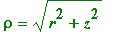

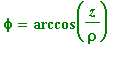 =
=
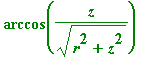
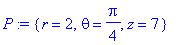
| > | P:={r=2, theta=Pi/4, z=7}; |
| > | ans[`6a.6`]:=[rho, theta, phi]=simplify(subs(P, [sqrt(r^2+z^2), theta, arccos(z/sqrt(r^2+z^2))])); evalf(ans[`6a.6`]); |
![ans[`6a.6`] := [rho, theta, phi] = [53^(1/2), 1/4*Pi, arccos(7/53*53^(1/2))]](images/Lesson_06a55.gif)
![[rho, theta, phi] = [7.280109889, .7853981635, .2782996592]](images/Lesson_06a56.gif)
| > |