Intricacy, Design, and Cunning in the Book of Judges
(Xlibris, 2008). Can be purchased online at xlibris.com, amazon.com,
etc.)
This, like all my work on the Bible, is a secular literary criticism
of the Bible and is not primarily theological. Since I always taught
in secular institutions, my criticism is consistent with my teaching
of ancient world literature. That is one of the things that makes my
book quite different from the traditional biblical scholarship.
|
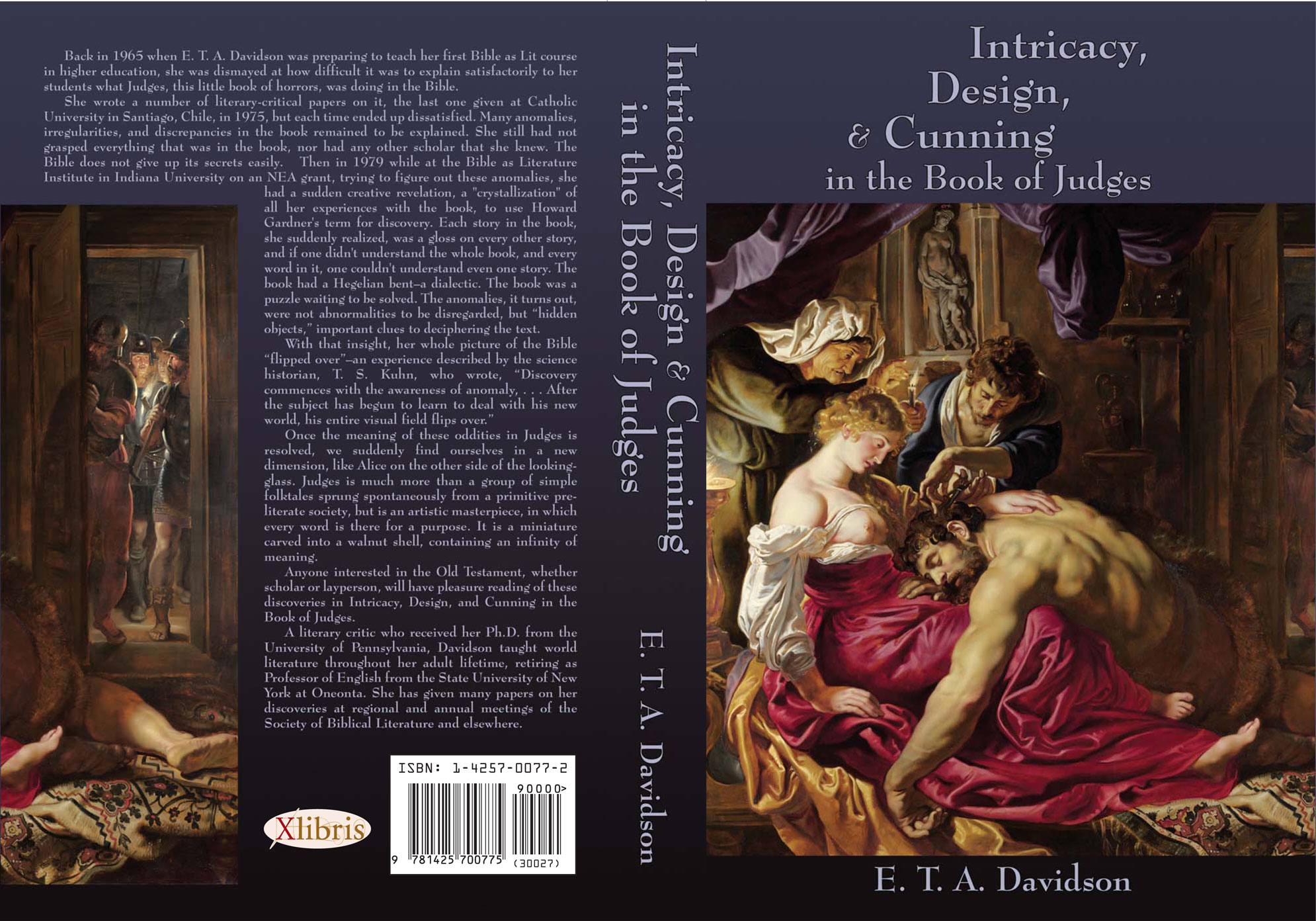 |
| Rubens' "Samson and Delilah", with permission of the National
Gallery, London. © 2006 |
Intricacy, Design, and Cunning in the Book of Judges
by E. T. A. Davidson
The Book
of Judges in the Bible is a deeply-disturbing anthology of short stories about
a people desperate for survival. A comedy of horrors, its dynamic interactive
tales–teeming with life–display secrecy, deceptions, spying, ambushes,
assassinations, murders, and dismemberments, clever, tricky underdog behavior,
improvised weapons, one passionate illicit love affair, and alas, gang rapes.
We can turn back to it again and again, puzzling over its kaleidoscopic turns,
and at each turn, the more we study it, the more we learn about human behavior
and the Israelites’ need for a code of ethics. As with all great art,
it is inexhaustible. Though about an ancient world, it teaches us much about
ourselves.
As for the
cover of the book, Davidson saw Rubens’ painting in the National Gallery
in London in 1990 and instantly chose it for the cover. She saw, but didn't
think much about the fact, that Delilah's breast is uncovered–until much
later when it came to her that many people will be shocked and offended by
it.
But she
won’t change it, as it illustrates many of the things that she found
in Judges. Judges is not about the greatness of Israel, but
about the decline of Israel, and it predicts what will happen if Israelites
don’t mend their ways. The painting illustrates the complexity, depravity,
humor, horror, beauty and most important, one reader’s (Rubens’)
personal interpretation of a spellbinding tale. We all fill in the gaps in
our own personal way–witness the differences between how Milton treated
Samson in his great play and Rubens’ understanding of him in this painting.
Judges is
in one respect an intricate puzzle waiting to be solved. Learning the secrets
of this ancient masterpiece of world literature and deciphering its profound
messages should give pleasure to all–whether religious or not. Intricacy,
Design, and Cunning in the Book of Judges penetrates its mysteries for
us.
Davidson,
for many years a professor of world literature, is also a biblical scholar.