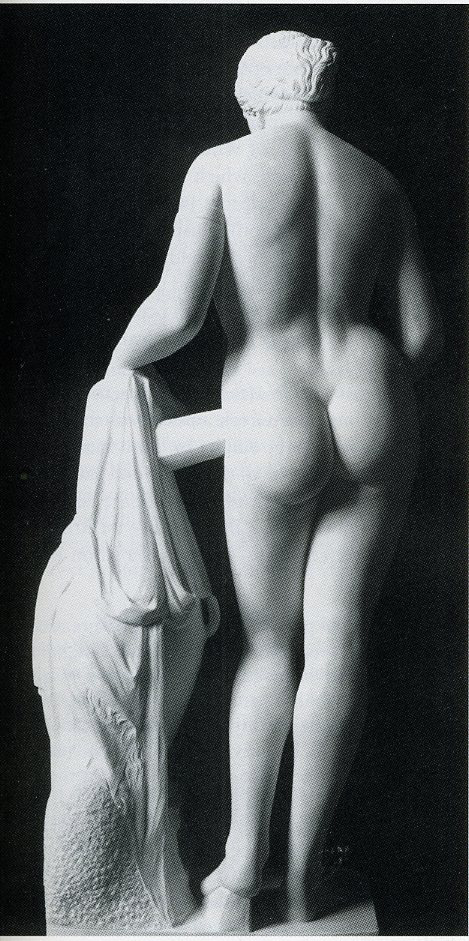
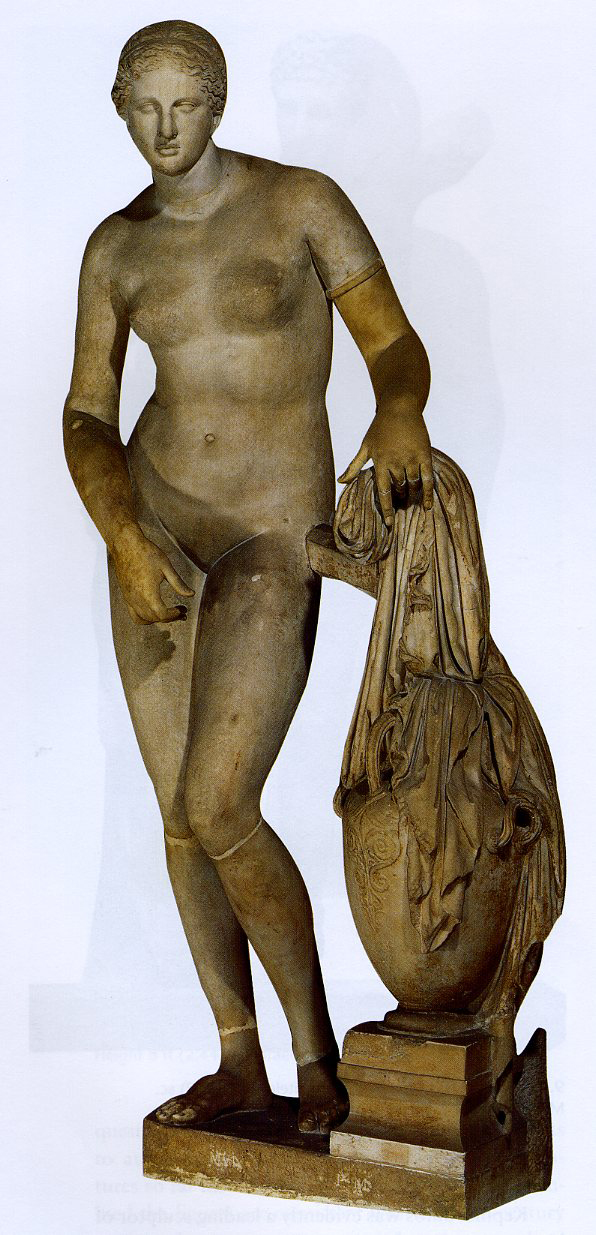
Back view of cast of Aphrodite of Knidos.
Art Home | ARTH 200 Assignments | ARTH 209 Assignments
The Aphrodite of Knidos and the Invention of the Female Nude in Greek Art
|
Back view of cast of Aphrodite of Knidos. |
|
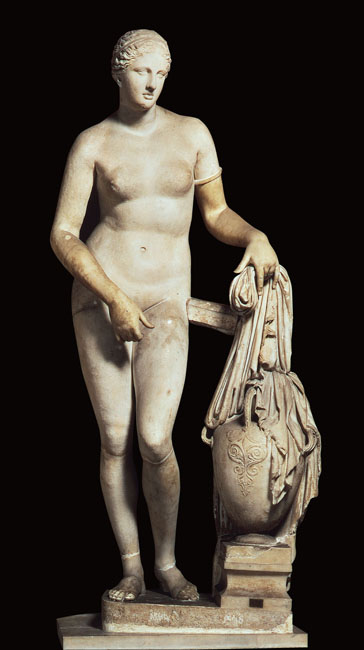
Praxiteles, Aphrodite of Knidos, c. 330 B.C.
Excerpt from Nanette Salomon, "The Venus Pudica: uncovering art history's 'hidden agenda' and pernicious pedigrees," published in Griselda Pollock, Generations and Geographies in the Visual Arts.
/p. 70Praxiteles' monumental sculpture, usually called the Knidian Aphrodite, was produced in the volatile period around 350 bce. It is known to us by the best surviving copy now in the Vatican museum. The Knidia's claim to innovation is made by its position in ancient Greek art as the very first monumental cult statue of a goddess to be represented completely nude. Moreover, and most significantly, it is the first monumental female nude sculpture to be positioned with her hand over her pubis, which at some undetermined moment in ancient times was given the highly manipulative / p. 71name 'pudica' or so-called modest pose. The politics of this name and its meanings, along with the general sexual cast of ancient legends surrounding the Knidia, will be discussed presently. For now it is significant that the literature on this work, in fact dating from antiquity to the present day, claims it to be 'the most popular of all statues in antiquity'. Its popularity was expressed not only in accolades of ancient writers but also in countless Hellenistic and Roman copies, adaptations and derivations 'inspired' by Praxiteles' concept. After the middle of the fourth century bce the female nude indexing her pubis was the most represented artistic configuration in the western world.
Yet, despite popular misconceptions that the female nude was always the classical subject par excellence, Praxiteles' introduction of the monumental female nude occurred at least three centuries after the introduction of its counterpart, the monumental male nude statue. It was, in fact, the male nude that dominated the early artistic avant-garde in ancient art of the archaic and classical periods. It is there we must seek the connections and constructions which provide the background for the advent of female nudity into the mainstream of western culture. Before coming to an understanding of the sexual and erotic definition of the female nude in Greek art, we must first explore/expose those of the male nude.
A survey of Greek monumental sculpture of men and women in the sixth and fifth centuries readily reveals the strong differentiation along gender lines already inherent in their definition.  In the archaic period the kouroi (athletic male youths) are fabrications of an idealized humanity defined as male, youthful, and heroicially nude.
 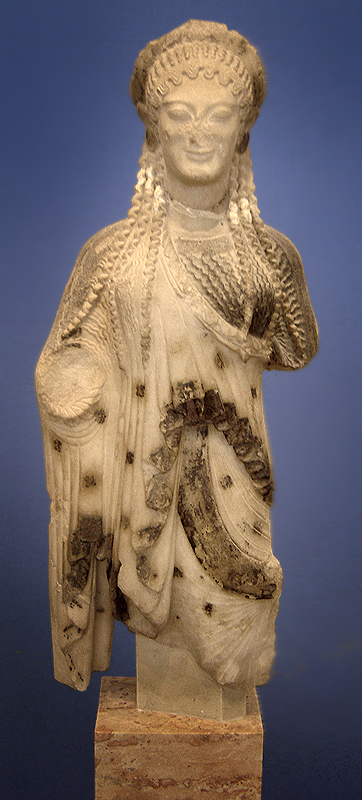 The correspondent female korai are, on the contrary, consistently draped. Further, given the collaborative project of Greek artists over generations and the resultant homogeneous nature of their art, the male anatomy continued in fifth-century classicism to be the form in which primary creative energy was invested. Its treatment is ever more precisely scientifically informed, culminating in
 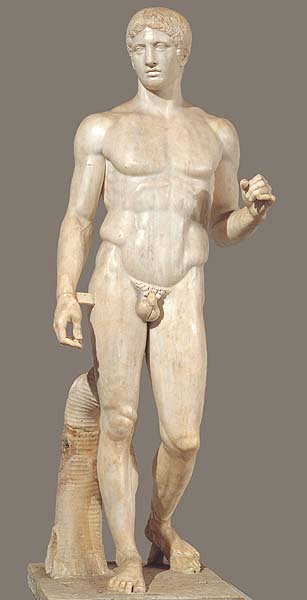 Polykleitas's Doryphoros, a work nicknamed the canon in its own time. The corresponding development traceable in monumental female sculpture, again by contrast, demonstrates ever greater virtuoso handling of drapery and the progressively plastic implications of hair arrangement. The male figure is portrayed as coherent and rational from within; the female figure is portrayed as attractive from without; the male body is dynamically explored as internally logical, organic unity; the female body is treated as an external surface of decoration.
The assymmetrical treatment of the nude male and the clothed female in archaic and classical Greek art can be matched with the by now well-known social and legal inequities between men and women in ancient Athens. In the formation of the polis or city-state, women were legally positioned somewhere between slaves and citizens, and under the law they fell closer to slaves than to citizens. The disfranchised state of women led to a progressive condition of total seclusion even within the walls of the home. Greek literary traditions, mythological, scientific, philosophical, from Homer to Aristotle, focused on gender differences and mutually corroborated the misogynistic position that women were less than men.
The artistic practice also coincided with the differentiated social practices of the city-state where young men in the gymnasium exercised in the nude in 'daily life', while women in public places were always discreetly covered. The practice of nudity in Greek athletics and art has been understood as a means they used to demarcate themselves from other ancient societies whom they deemed barbaric. For work produced from in the sixth and fifth centuries it was also a cultural sign that differentiated male from female. In a deeper sense, the practice of preserving an idealized concept of youthful nudity exclusively for the masculine subject had a strong historical relationship with the Greek definition of beauty, which was defined specifically as a male attribute and ultimately with Greek homoerotic desire. For the Greeks, as in nearly all cases where the object of aesthetic admiration is the male form, the enjoyment of the male body is conjoined with homoerotic desire. Much has been written in recent times on Greek 'homosexuality' and its practice cannot but have bearing on the invention /p. 72 and dissemination of heterosexual desire as embedded in the histories of the Knidia. Homoerotic impulses were considered natural in ancient Greece, and socially legitimate desire contributed to the forming of the male nude as an ideal. In our context, it is significant that overt sexual references are not part of the conventions or codes of monumental sculptures of nude men. That is to say, male sexual organs are presented like any other body part, having no special claim to our attention. The penis is represented in the same straightforward manner that an elbow, knee, nose or foot are. Indeed, a boy's sensuality is defined by the gracefulness and coherence of his body in its entirety rather than by explicit reference to any particular body part. This is, however, not the case when the monumental female nude is introduced into Greek sculpture.
Praxiteles' Aphrodite is in the condition of both complete nudity and self-conscious nakedness. The idea of Praxiteles' nude Aphrodite covering her pubis soon became an enormous success, generating an endless stream of derivations, imitations and replicas. The Knidia can be seen as the starting point of a new history in art. It is a history that privileges the female over the male nude. Further, it is a history that sexually defines the represented woman by her pubis and, on that account, keeps her in a perpetual state of vulnerability.
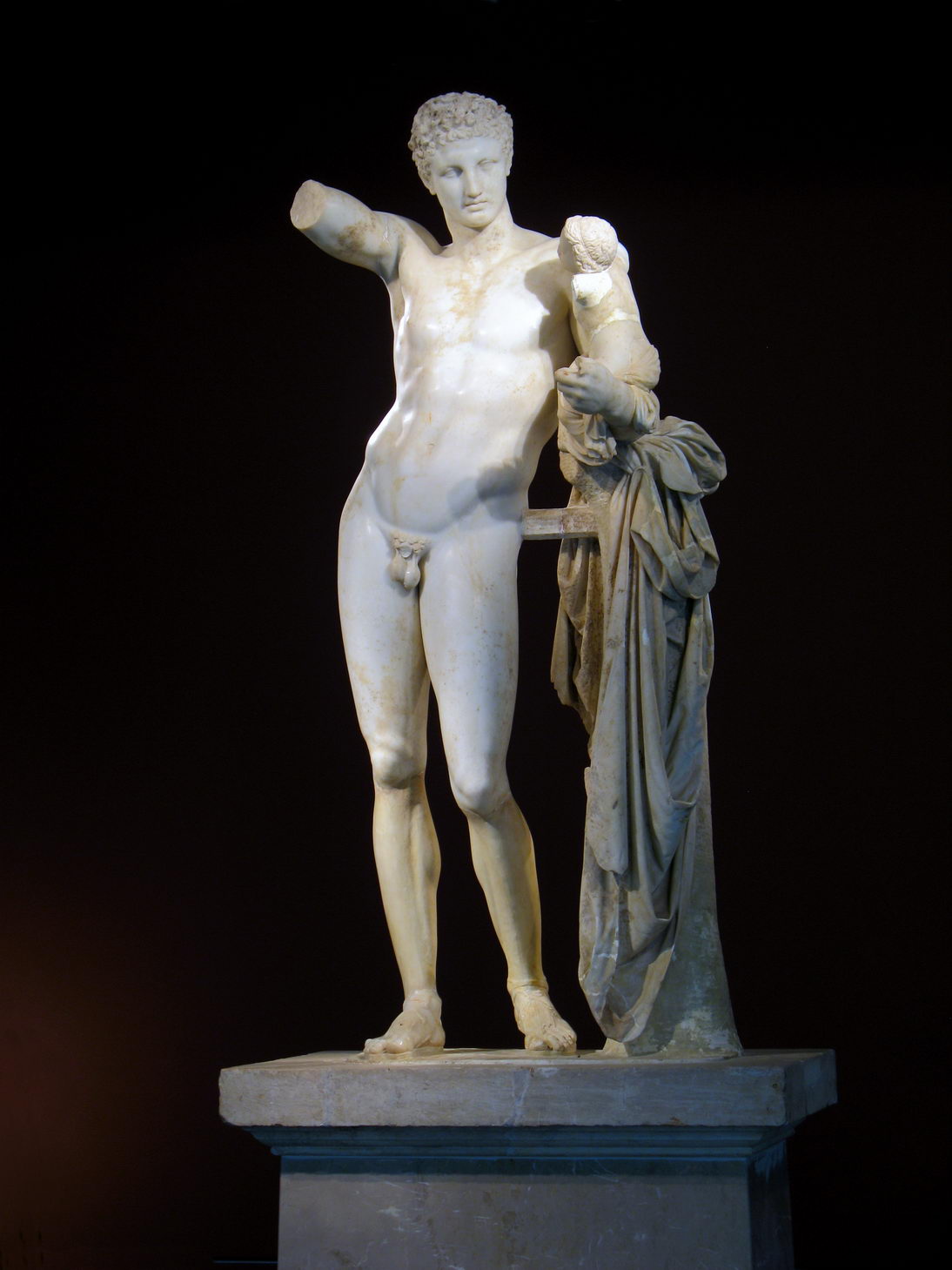 A comparison between Praxiteles' Hermes with the Babe Dionysus, representing the end of the kouros tradition, and the Knidian Aphrodite, representing the beginning of the Venus pudica tradition, immediately reveals the asymmetrical terms of their nudity. It establishes the artistic codes of female /p. 73 nudity as fetishized, and provides the visual basis for the concomitant unequal power relations. In contrast to the heroic, iconic nudity of Hermes, the Knidia, more naked than nude, is sexually coded by the ambiversive placement of her right hand in front of her pubis. The issue of whether she, like the various pre-archaic, Mesopotamian or Mesopotamian-inspired Greek archaic statuettes usually cited as her heritage, points to herself as to her powers of fertility, or whether she is, in fact, covering herself before the eyes of an intruder, can never be resolved. Praxiteles' intentions, like his original work, have long since disappeared.
In any reading, the hand that points also covers and that which covers also points. We are in either case, directed to her pubis, which we are not permitted to see. Woman, thus fashioned , is reduced to her sexuality. The immediate and long-term implications of this fiction in the visual arts are incalcuable. The form taken for Aphrodite reincarnate results in an endemic and inescapable presence of Woman as exposed and vulnerable. What is at stake here, then, is fundamental to our understanding of ourselves and our images of self as a sexual, deployed 'other' though the conditioning of culture.
An aspect of the critical literary history of the Knidia becomes particularly relevant here. The history of the Knidia's reception is plagued by a vacillation between appreciating it as a work of art or as a real woman. This informs, although it does not thoroughly explain, how realistic works like this affect expectations and evaluations of real women. As an underlying principle, the mimetic naturalism of all Greek art must stand as a contribution factor. More than one /p. 74 classical myth (such as Pygmalion) deals with the miraculous conversion of sculpture to life. 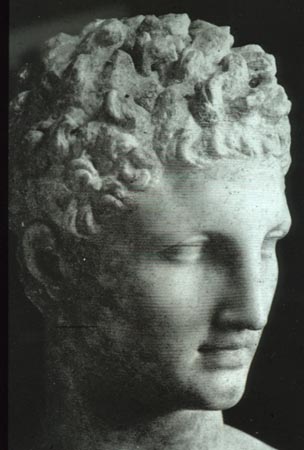 Praxiteles, in particular, was renowned for naturalizing the gods, making them more human and life-like than ever. His virtuoso ability to miraculously transform cold marble to the look of real vibrant flesh, vulnerable and sensual, is frequently acknowledged. The contraction and collapse of art and life is especially dire in the reception of the Knidia.
Ancient legends retold by Pliny, Lucian, and others add to the implosion of meaning of art and life, profoundly confusing the approach to a sculpted Greek goddess, albeit the goddess of love, and the approach to a sexually vulnerable woman. The stories include one of a sailor so enamoured of the Kndia that he contrived to be locked in the shrine with her overnight, leaving semen stains on the sculpture as a testimony of his lust. Another story tells of the shrine's caretaker, who, for extra payment, would open the back so that her buttocks can be admired, On another level of myth-making and added further dimensions to the sexual discourses of the work is the ancient story told of Phryne, a courtesan renowned for her beautiful breasts , who as Praxiteles' lover served as the Knidia's model. Such discursive activity which abets, as Martin Robertson put it, 'the indistinguishability of the statue from a beautiful and desirable woman' ideologically tells us what the conditions of that desirability are and causes those conditions to appear unaccountably 'natural'.
The conditions of desirability presented in Praxiteles' creation shed light on its enduring popularity as a benchmark for the construction of woman as perpetual rape victim in western European art. The Knidia is portrayed holding drapery in her left hand above a vase. This gesture, like the work as a whole, functions on the level of both icon and narrative. Iconically, this type of image recalls Aphrodite's connection with water as she was born from the sea. On the level of narrative, it communicates that she, as a grown woman, was in the process of bathing. The rest of her body language, such as the slight crouch of her body, the turn of her head to one side and the way she pulls her free leg in to press her legs together firmly, weight a narrative over iconic reading. In general, Praxiteles' works such as the Apollo Sauroktonos or Hermes with the Baby Dionysos show how invested he was in developing narrative in monumental cult art.
The most telling gesture, however, is that of the right hand before the pubis. The gesture constructs a sexual narrative of protective fear that is conveyed by her body language as a whole. As she leaves her bath, the goddess hears someone coming and in modesty and fear urgently protects herself. Praxiteles has created a goddess vulnerable in exhibition, whose primary definition is as one who does not wish to be seen. In fact, being seen is here undeniably connected with being violated. Praxiteles has installed in us much more than the controlling male gaze. He has transformed the viewer into a voyeur, a veritable Peeping Tom. We yearn to see that which is withheld. The viewer's shameful desire to see matches the sculpture 'modest' desire to not be seen.
In this gesture, which so dominates the Knidia, that has given the artistic type its name of pudica. The word 'pudica' is etymologically related to 'pudenda' a word that simultaneously means both shame and genitalia [Pudor: From Latin pudor (“sense of modesty or shame”), from pudet (“it shames”), as is pudency (via pudentia)]. This appalling conflation goes back to the doubled meaning of the Greek root word aidos, aidoios. The earliest application I have found of this linguistic doubled meaning and the artistic gesture/ pose is in the Erotes by the Pseudo-Lucian. There, in his description of the sculpture, he says it is the Knidia's aidos that she covers with her right hand [passage is translated in the excerpt below as "Nothing hides her beauty, which is entirely exposed, other than a furtive hand veiling her modesty."] His ideological, political choice of word for that body part has given the gesture /pose its art-historical name ever since. It should then be revealing to explore, if only summarily, what is communicated by the ancient Greek notion.
First and foremost, the etymological connection situates those "things about which one must have pudor, modesty, shame, and respect" with sexual demeanour. Although theoretically aidoios is used for both male and female sexual organs, tracking the practically differentiated significance of the ethical term for men and women confirms those differences already seen in their artistic formations. It also reminds us that cultural sexuality is a discursive cipher for so much more than 'actual' sexual relationships.
/p. 75: For the Greeks, aidos is a virtue to be taught as part of a young boy's education between the ages of fourteen and twenty to balance out his natural tendency to hubris or arrogance. Plato defines this modesty as the fear of seeming perverse when we do or say something that is not good. It is commonly applied to the sexual realm. Moreover, aidos is related to the all-important Greek notion of sophrosyne, meaning soundness of mind, sobriety and self-control, the trait which allows one to master one's desires by exerting rational control. While the term is used with complex and profound implications for the male's physical and psychological well-being, feminine sophrosyne, according to Anne Carson 'always includes, and is frequently no more than, chastity.' Even when sophrosyne does concern both male and female chastity, as it comes to in the second half of the fifth century, the conditions of that chastity are differentiated.' Masculine chastity derives from self-control, the opposite of ol, the opposite of hybris, feminine chastity from obedience. Aristotle makes clear that for the man sophrosyne is rational self-control, for the woman it is dutifulness and obedience. For the man, control comes from within, for the woman, since she cannot control herself, it must be exerted from the outside. He finds that women are equally incapable of possessing aidos, and that society must work to impose modesty on them. Once again man, as his image, is constructed as managed internally, woman, as her image, is constructed as managed externally.
The sculpture, coming after three centuries of repressed female nudity, commands a situation loaded with titillating and erotic possibilities. It stimulates desire by fashioning a sexual reading onto the nude female body. /p. 76 and into the sight of the spectator. By covering her pubis, Praxiteles makes her pubis the most desirable thing to see/have, the unjaded viewer cannot not think about her pubis while standing before her. We, however, as habitual viewers of an art tradition that is so saturated with this gesture, ingest but no longer see Aphrodite's pubis.
While the term 'pudica', shameful or modest, often describes this gesture, it does not actually convey the motivation behind the body language. It does, however, define an aspect of female sexuality as it was constructed in the ancient world. It does so by constructing the female as the opposite of the aggressive unseen male. Foucault, and Dover before him, discusses Greek sexual relations as always conceived of as 'being of the same type as the relationship between a superior and a subordinate, an individual who dominates and one who is dominated, one who commands and one who complies, one who vanquishes and one who is vanquished'. While such sexual practices were apparently equally operative in the love of boys and women, in monumental Greek sculpture they find expression only in the female form.
For us the real issue lies not in retrieving the 'original' meaning of the subject /pose/ gesture, whatever that may have been, but rather in how the work was absorbed as ideology; how it was most often and consistently understood and how it may have been creatively, ideologically misunderstood. The initial reaction to Praxiteles' innovation in subsequent ancient sculpture stresses what was considered the most rewarding and exciting aspect of his work. 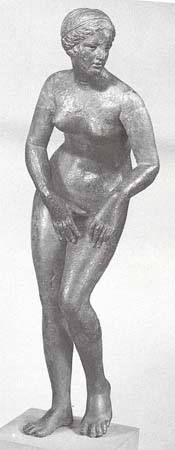 The Hellenistic bronze sculpture now in the the Metropolitan Museum eliminates /p77 any trace of Praxiteles' brilliant ambiguity in the gesture and presents instead an explicitly defensive one. Just as the rest of this work's visual language describes a true surge of adrenalin, the crouch of her body and turn of her head are more pronounced and produce with greater unity an image of protective fear against unwelcome surveillance. She is titillating and provocative in her overt sexual vulnerability.
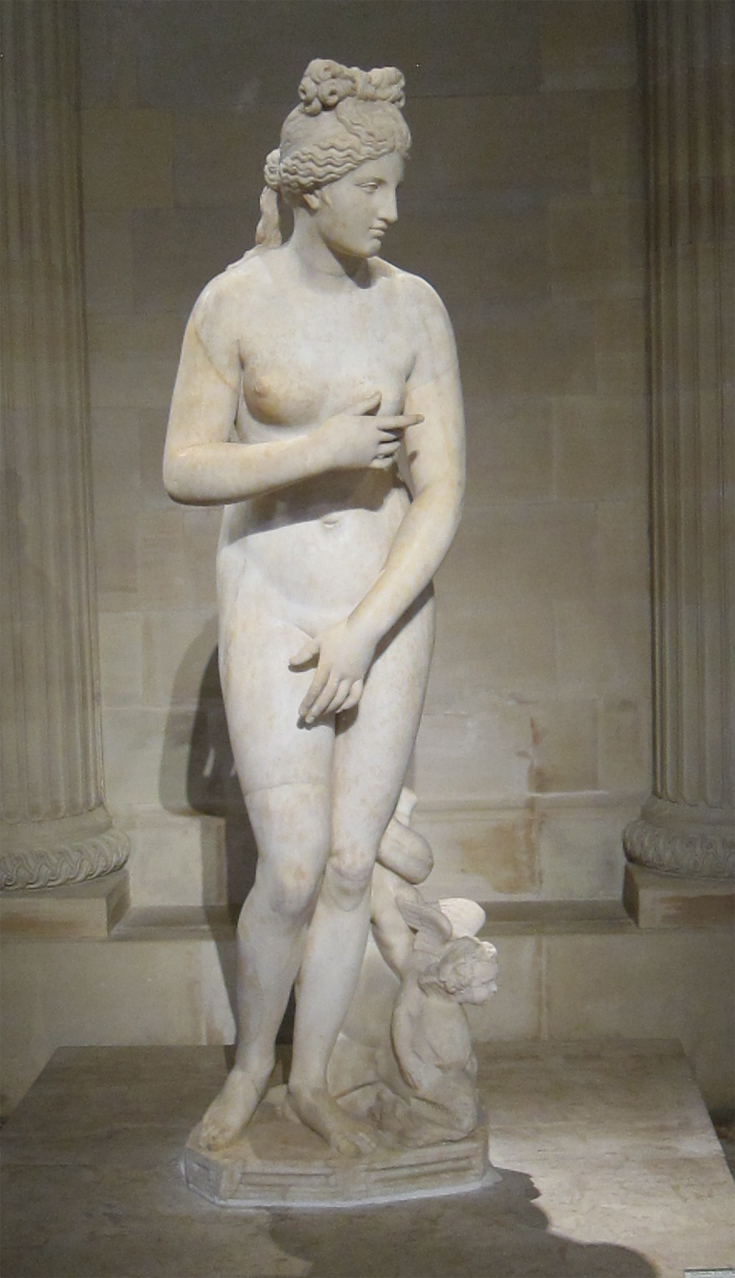
More insidious still are the many slightly later artistic derivations of the Knidia created in the Hellenistic and Roman periods which repeat the gesture without any of the other visual indications of the narrative. 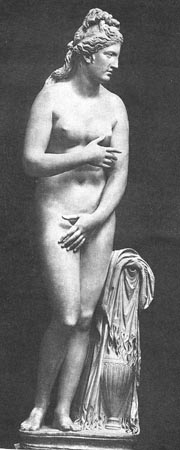 The female nude, thus, has her hand placed over her pubis and frequently also over her breasts in a completely abstract way, with no other apparent explicative gesture or expression. This is the case, for example, with the most oft-cited derivation, the Capitoline Venus. Aside from covering their pubis and breasts, these figures express neither pride in the source of their fertility nor shame for their exposed sexual organs. In fact, a peculiar feeling of vacuousness characterizes the representation of women in these works. This form of dissimulation results in the disenfranchised gesture / pose which can then only be understood as some sort of deep and enduring attribute of women in general rather than a momentary reaction to a specific situation.
Different Desires:
A Dialogue Comparing Male and Female Love
attributed to Lucian of Samosata
Translation copyright 2000 Andrew Kallimachos
Lucian of Samosata, the prolific second century CE Greek satirist and tireless traveler, is thought by many not to have authored the present text, Erotes. The various descriptions of the places visited by the protagonists seem rather to fix the date of the work around the beginning of the fourth century CE. Nonetheless, even though its style is unlike that of his other works, its essence is in keeping with Lucian's custom: 'ridendo dicere verum,' 'laughingly to say the truth.'
11. We could not pass up the chance to stop in Cnidus, where there is so much
to be seen, notably the temple of Aphrodite which encloses the statue by Praxiteles,
so admired for its beauty. We made a gentle landfall amid a splendid calm, as
if the goddess herself had propelled our vessel. After alighting, and while
rooms were being arranged, I took the two experts on love by the arm and we
went round Cnidus, delighting in the erotic terra cottas, worthy of a town dedicated
to Aphrodite. After having seen the portico of Sostratos and a couple of other
landmarks, we directed our steps towards the temple of the goddess, Charícles
and I with the greatest satisfaction, but Callicratídas not without some
reservations, as if this visit were an homage to a woman. He would have, I believe,
willingly traded the Aphrodite of Cnidus for the Eros of Thespiae.
12. As soon as we reached the confines of the temple we felt as if caressed by the very breath of the goddess. The floor of the court had not been doomed to sterility by a stone pavement, but on the contrary, it burst with fertility, as behooves Aphrodite: fruit trees with verdant foliage rose to prodigious heights, their limbs weaving a lofty vault. The myrtle, beloved by the goddess, reached up its berry-laden branches no less than the other trees which so gracefully stretched out. They never know foliage grown old, their boughs always being thick with leaves. To tell the truth, you can notice among them some infertile trees, but they have beauty as their fruit. Such were the cypress and the planes which towered to the heavens, as well as the tree of Daphnis, who once fled Aphrodite but now has come here to seek refuge. Ivies entwine themselves lovingly around each of these trees. Heavy clusters of grapes hang from the gnarled vines: indeed, Aphrodite is only more attractive when united with Bacchus; their pleasures are sweeter for being mixed together. Apart, they have less spice. Under the welcome shade of the boughs, comfortable beds await the celebrants - actually the better people of the town only rarely frequent these green halls, but the common crowds jostle there on festive days, to yield publicly to the joys of love.
13. When we had exhausted the charms of these places we pressed on into the
temple itself. The goddess stands in the center; her statue made of marble from
Paros. Her lips are slightly parted by a lofty smile. Nothing hides her beauty,
which is entirely exposed, other than a furtive hand veiling her modesty. The
art of the sculptor has succeeded so well that it seems the marble has shed
its hardness to mold the grace of her limbs. Charícles, dazed by this
spectacle, impulsively burst out, "Lucky Mars, to be chained by such a
goddess!" He rushed forward as he spoke, lips pursed, neck stretched to
give her a kiss. Callicratídas watched the display in silence. The temple
has a second entrance for those who wish to contemplate the goddess from behind,
for none of her parts should escape admiration. It is easy in that fashion to
gaze upon her hind beauty.
14. Wanting to see the goddess entire we approached this gate. Upon being let
in by the woman who kept the keys, we were overwhelmed by her abundant beauty.
As soon as the Athenian, who had so far been indifferent, glimpsed this side
of the goddess, which reminded him of boys, he exclaimed with even greater enthusiasm
than that of Charícles, "By Hercules, what a harmonious back. What
rounded thighs, begging to be caressed with both hands! How well the lines of
her cheeks flow, neither too skinny, showing the bones, nor so voluminous as
to droop! How inexpressible the tenderness of that smile pressed into her dimpled
loins! How precise that line running from thigh, to leg, to foot! Now I can
understand why Zeus' nectar is so sweet when Ganymede pours it. As for me, I
would never take it from Hebe's hand." While Callicratídas was declaiming
this speech with much elan, Charícles remained fixed in place, the tenderness
of his gaze betraying his emotions.
15. Filled with admiration, we noticed behind one of the thighs a stain like
one on a robe, which only brought out the whiteness of the marble. It seemed
a flaw in the stone. This kind of defect is not uncommon, and fate thus tends
to thwart that which otherwise would reach perfection. Supposing this dark stain
was natural, my admiration for Praxiteles only increased, for having so skillfully
hidden it where it would least be noticed. But the groundskeeper, who had stayed
by our side, recounted an extraordinary and barely believable tale on this subject. "A young man from a distinguished family," said she, "but whose
act has made the name unspeakable, came often to the temple, where an evil spirit
had made him fall in love with the goddess. As he spent his whole day there,
it was first believed to be due to a faith bordering on superstition. In fact
he was up way before the dawn, and only went home after sunset, having spent
all his time seated before the goddess, his eyes constantly fixed upon her.
You could hear him murmuring sweet nothings to her.
16. When he wanted to quench his passion a bit, he would make an invocation,
cast on the table four small bones of Libyan gazelle, and read the future in
them. If the throw was lucky, especially if it was the one called ‘of Aphrodite,'
when none of the dice shows the same number, he would prostrate himself, certain
his desire would soon be fulfilled. But the opposite was more common, and when
the dice were unfavorable he cursed all of Cnidus and, as if his misfortune
were incurable, was overwhelmed by sadness. In the next moment he would gather
up the dice and try his fortune again. His passion only grew stronger, and he
carved on every wall and tree the name of Aphrodite the Beautiful. He worshiped
Praxiteles as equal to Zeus. Any beautiful or valuable thing he found in his
house he offered to the goddess; finally, the violence of his desires made him
lose his reason, his audacity serving him for pimp. One evening, at sunset,
he slid unseen behind the temple door and hid in the darkest corner, holding
his breath. The keepers closed the gate as usual, and this new Anchises found
himself alone inside. Who would dare recount the sort of deeds he consummated
that wicked night? In short, at daybreak this sign of his amorous embraces was
discovered, a sign which ever since has marked the goddess as a reminder of
her suffering. As for the young man, they say he threw himself upon the rocks,
or into the sea. In any case he disappeared forever."
17. Before the attendant could make an end to her story Charícles exclaimed,
"So! Even made of stone, a woman wants loving. How then if such a beauty
came to life? Would not a night with her be worth Zeus' very scepter?"
Callicratídes replied, smiling, "We don't know yet, Charícles,
whether many more such stories lie in store for us once we reach Thespiae."<3> "What do you mean?" asked Charícles. Callicratídes answered,
not without reason. "It is claimed," said he, "that this young
lover had a whole night to satisfy his passions at his leisure. Yet he dealt
with the statue as with a boy, thus proving he was not seeking the woman in
front." When other comments along these lines brought tempers to a boil,
I said to them, after calming them down, "O very dear friends, if you are
going to argue, do it properly, according to the blessed rules of contest. Stop
this disorderly and fruitless spat. Let each of you defend his cause in proper
fashion. It is not yet time to board. Let's put this moment to good use in the
service of enjoyment, exploring these serious matters in a way that combines
pleasure and profit. Let's leave this temple since people are starting to crowd
in for their devotions, and let us repair to the garden, there to listen and
talk to our heart's content. But remember, he who is bested today is never again
to reopen this discussion."
18. It seems I had not spoken in vain, for both agreed. We left, I thrilled
to have nought to do but listen, they deeply absorbed in thought, as if upon
this debate hung in balance an Olympic prize.<4> When we arrived in a
suitably shady nook, offering shelter from the heat of the day, I said to them,
"Here is a splendid spot. The songs of the cicadas overhead will be our
accompaniment." I sat down between the two antagonists like a true judge,
the weight of the Athenian Tribunal heavy on his brow. I had them draw lots
to choose the first speaker. Charícles won, and I bade him begin his
speech at once.
19. He passed his hand over his brow and, after a moment of silence, began thus: "O Lady mine, O Aphrodite, my prayers call upon you to sustain my plea
for this your cause. Every undertaking, no matter how small, attains perfection
if you but bestow upon it the least measure of your mercy; but matters of love
have special need of you, for you are after all their natural mother. Come as
a woman to defend women, and grant that men remain men, as they were born to
be. At the very start of this debate I call as witness of the truth of my words
the primordial Mother, original source of all creation, by which I mean the
sacred nature of the universe, she who, having been the first to unite the elements
of the world — earth, air, fire and water — wrought through their
mingling all living creatures. As she knew we were a meld of perishable stuffs,
granted an all too short existence, she made it so that the death of one would
be the birth of another, and that procreation would keep in check mortality,
so that one life could send forth another in infinite succession. Since a thing
cannot be born of a single source, to each species she has granted the two genders,
the male to which she has given the seed principle, and the female which she
has shaped into a vessel for that seed. She draws them together by means of
desire and unites one to the other in accordance with the healthy requirement
of necessity, so that, each remaining within its natural bounds, the woman will
not pretend improbably to have become a man, nor will the man wax indecently
effeminate. It is thus that the unions of men with women have perpetuated to
this day the human race, through an undying chain of inheritance, instead of
some man claiming the glory of being uniquely the product of another man. Quite
the contrary, all honor two names as equally respectable, for all have a mother
and at the same time a father.
20. Thus in the beginning, when men lived imbued with feelings worthy of heroes
they honored that virtue that makes us akin to the gods; they obeyed the laws
fixed by nature and, conjoined with a woman of appropriate age, they became
fathers of virtuous children. But little by little the race fell from those
heights into the abyss of lust and sought pleasure along new and errant paths.
Finally, lechery, overstepping all bounds, transgressed the very laws of nature.
Moreover, the man who first eyed his peer as though a woman, could he have helped
but resort to tyrannical violence, or else to deceit? Two beings of one sex
met in one bed; when they looked at one another they blushed neither at what
each did to the other, nor at what each had suffered to be done to him; sowing
their seed (as the saying goes) upon sterile rocks they traded slight delight
for great disgrace.
Pliny, Natural History, 36,20-21: I have mentioned the date of Praxiteles among those sculptors who worked in bronze; yet in his fame as a marble-worker he surpassed even himself. There are works by him at Athens in the Ceramicus, but first and foremost not only of this, but indeed in the whole world, is the Venus that many have sailed to Cnidus to see. He made two statues and put them up for sale together: one was draped and for that reason was preferred by the people of Cos, who had an option on the sale, even though it was the same price as the other, for they judged this to be the sober and proper thing to do. The Cnidians bought the rejected one, whose fame became immensely greater. Later King Nicomedes wanted to buy it, promising that he would pay off the city's entire debt, which was enormous. The Cnidians, however, preferred to suffer anything but this, and not without reason, for with this statue, Praxiteles had made Cnidus famous. The shrine she stands in is completely open, so that one can view the image of the goddess from all sides, an arrangement (so it is believed) that she herself favored. The statue is equally admirable from every angle. There is a story that a man was once overcome with love for it, hid inside during the night, and embraced it, leaving a stain to mark his lust. In Cnidus there are other marble by famous artists...but there is no greater witness to the quality of Praxiteles' Venus that among all these it alone received attention.
Related works to Aphrodite of Knidos:
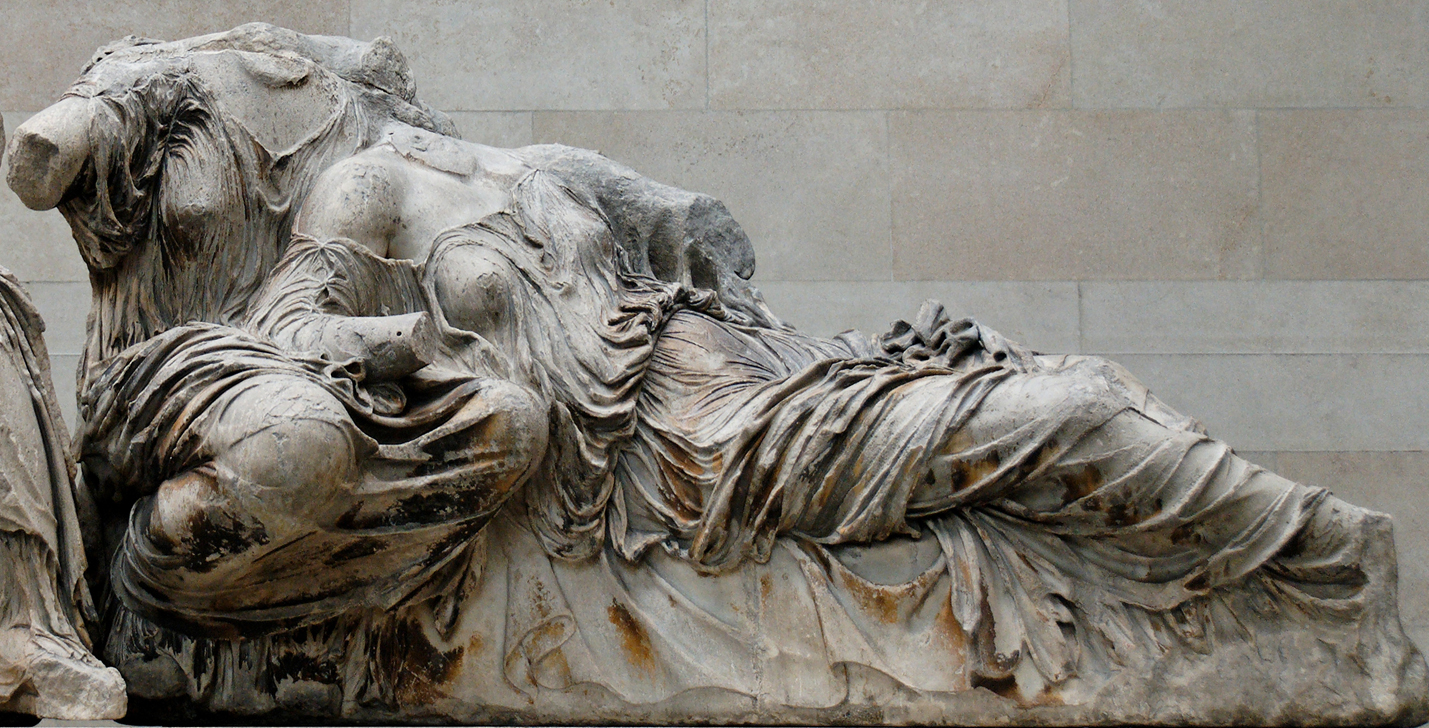
Probably the figure of Aphrodite from the East Pediment of the Parthenon, 447-432.
|
||
Capitoline Venus, Roman copy of a Hellenistic original, c. 120 B,C, |
London, British Museum version of the Capitoline Venus, Roman, 2nd century A.D. |
Paris, Louvre version of the Capitoline Venus/ |
Aphrodite, Knidian type, c. 150-100 B.C. |
Medici Aphrodite. |
|
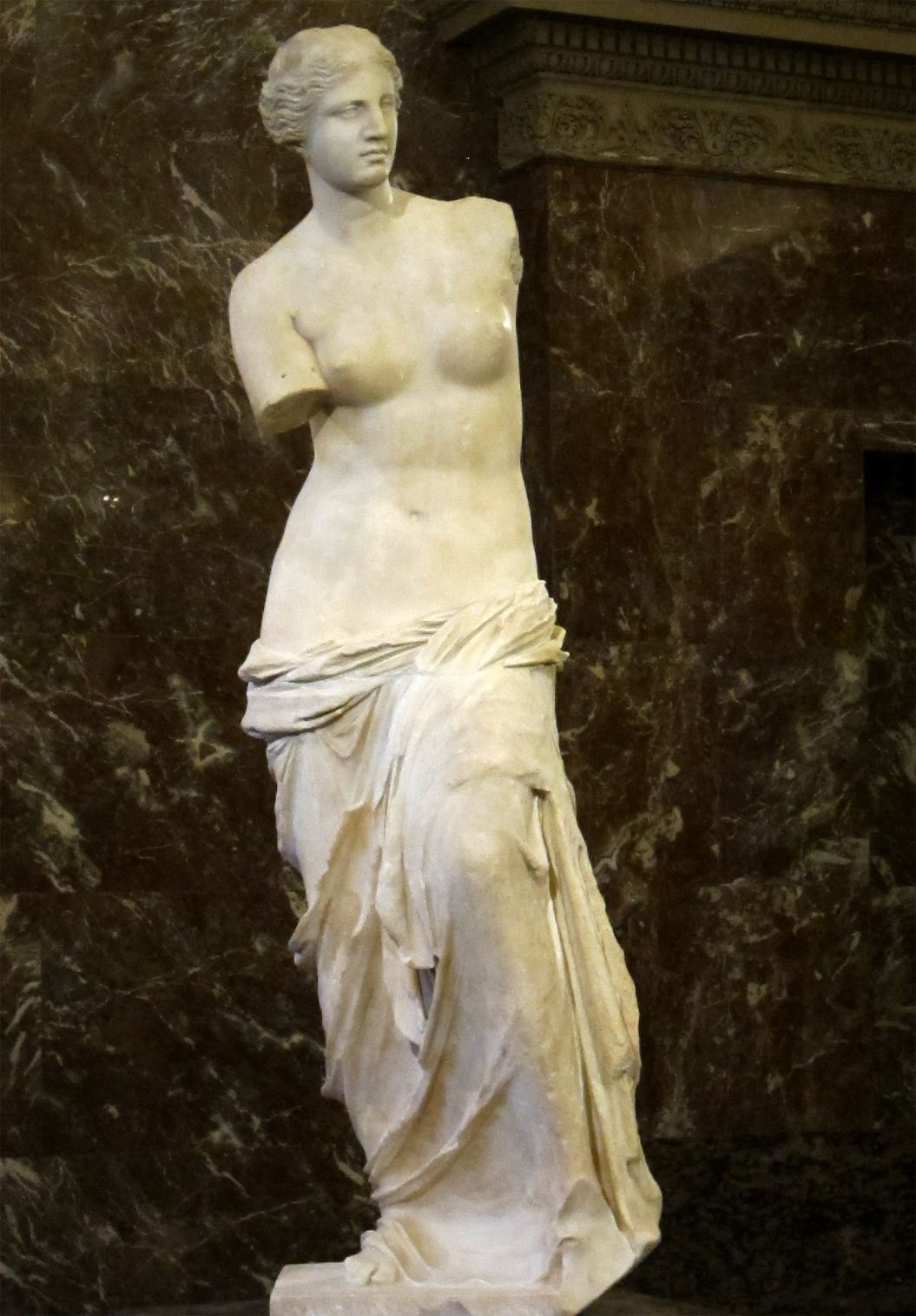
Aphrodite of Melos, c. 150 B.C. |
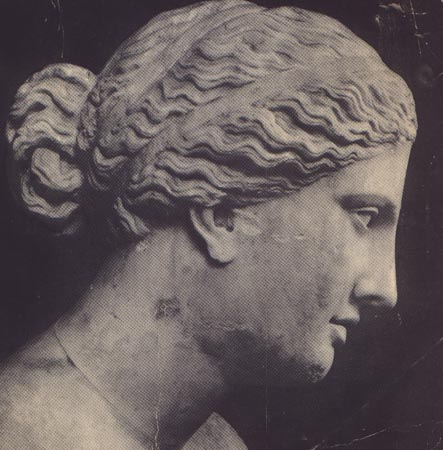
Detail of head of the Aphrodite of Knidos
|
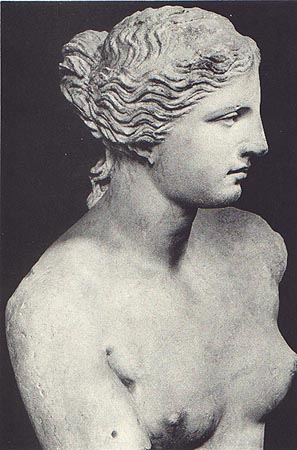
Detail of the Aphrodite of Melos |