Graphical User Interface (GUI)
When the 1984 Macintosh computer entered the market, most computers performed tasks by the user entering text based commands that required a steep learning curve. The Graphical User Interface used icons that were metaphors for common organizational items such as desktop, folder, calendar, calculator, and trash can. The research for this interface grew out of studies of how children learned, and was developed by Douglas Engelbart in his groundbreaking work on human-computer interaction. The concept was first used by Xerox in their early computers.
Users could point to the icon and click the mouse to issue a command. This action took moments to learn, and had immediate visual results.
Graphic designer were able to relate to the icons that were metaphors for the traditional tools they used to perform the tasks all along. They could learn the programs relatively quickly based on discovering uses for each affordance.
The original icons were designed by artist/designer Susan Kare.
When affordances are taken advantage of, the user
knows what to do just by looking...
Donald Norman, The Design of Everyday Things, p.9
At a very simple level, to afford means 'to give a clue.'
Donald Norman, 1988
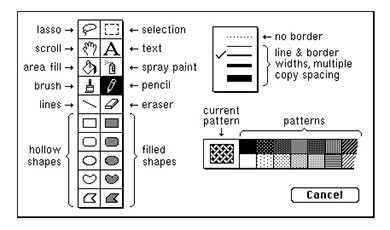
Interface for MacPaint program that shipped with a 1984 Macintosh.
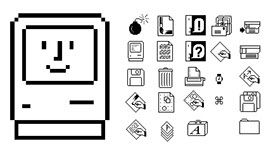
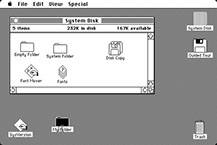
Desktop icons
Reference:
Wikipedia, Graphical User Interface
Norman, Donald. 1988. The Design of Everyday Things. Basic Books.