ARTH 200 Assignments
Spring, 2014
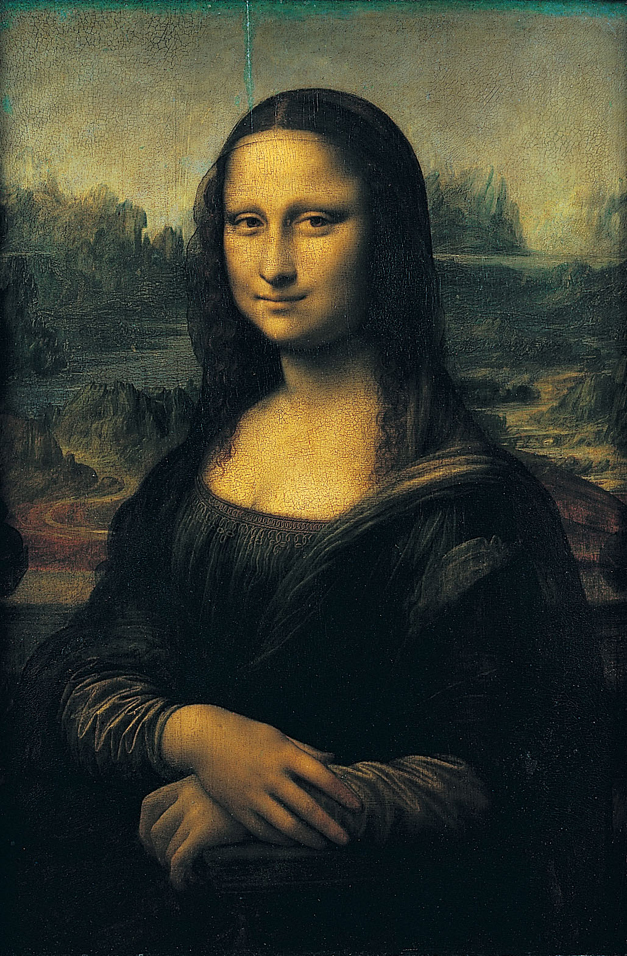
Thursday, January 16: Introduction. Looking will be a major issue in this course. It is not just how we look, but how the images look at us. Early in the semester we will be looking at early Renaissance paintings of images of women like Ghirlandaio's painting of Giovanna Tournabuoni: 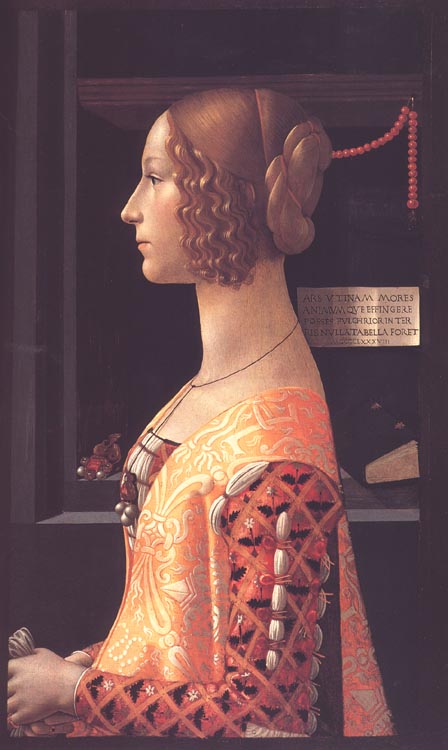 . Here the woman is an object to be looked at. Notice that her beauty is largely a product of culture. Her "natural" beauty has been transformed by culture. Consider the radical difference to Leonardo's Mona Lisa:
  . The following is a painting by the Flemish 17th century artist, Peter Paul Rubens. It is a portrait of his wife, Isabella Brant:
  What is your response to this painting? For us with modern advertising, this figure is almost a cliché, but in historical context, the potency of the way Isabella looks is very powerful. While she still has the clothing and symbols of status, Rubens puts more emphasis on Isabella's sensuality. Rubens wants the viewer to imagine touching her. Consider the role you play in looking at the painting.
Tuesday, January 21: review web-page entitled First Assignments. As indicated, include in your journals your "denotative" and "connotative" readings of the Hopper painting. E-mail me your entries.
Thursday, January 23: respond to the assignment for this date included on the First Assignments web page.
Tuesday, January 28: bring a copy of your draft of your first paper to class to be workshopped. The work of Isabel Bishop presents an interesting alternative to the vision of the working woman of Hopper. Bishop's paintings focus on young female office workers. Consider the contrast to Hopper to the images on the page dedicated to Bishop's work. I encourage you to read the essay by Ellen Wiley Todd, "The Question of Difference: Isabel Bishop's Deferential Office Girls."
We will be examining contemporary images of women at work. Here I want to draw upon images from advertising. See the page entitled Women at Work presents a few examples I have collected. Review them in advance of the class, and be prepared to identify the codes you see in operation in these. Record your responses in your journals
Thursday, January 30: First papers are due. Review the material included on the page entitled The Social Construction of Gender. From this page select a quotation that was meaningful to you or that you did not understand or that you disagree with. Write this quotation in your journal, and write a response to it. Be prepared to share your quotation in class on Thursday.
Tuesday, February 4: Review the page entitled [Female] Nude. Focus on the comparison of the Venus of Willendorf to the Venus de Milo (aka Aphrodite of Melos). Consider the relevance of the quotations at the outset of the page to your understanding of the comparison.
Consider the work of Anna Utopia Giordano in her Venus Project in which she has Photoshopped some of the traditional images of Venus to make her conform to our ideal.
Introduce Second Paper Assignment.
Thursday, February 6: Review the page entitled From Snake Goddess to Medusa. Much of the class will be focused on a comparison of the figure of the so-called Snake Goddess from Minoan culture of the second millenium to the mythological figure of Medusa that was represented in Greek art especially beginning in the seventh century and into the Archaic period. I have asked you to respond to these images in your journals.
Tuesday, February 11: bring in sample advertisements to workshop for your Second Paper Assignment. We will review page of Sample Advertisements to brainstorm approaches to the paper. Look at the web page entitled Looking and the Gaze.
Thursday, February 13: Probably no monument is more symbolic of western culture as the Parthenon constructed between 447-432 BCE. It was created as a monument to Athena and Athens' position in the world. I want to consider it from the perspective of the construction of gender. Review the web page I have created on Gender Construction and the Parthenon. To give a context for construction of gender in Archaic and Classical Art review the web pages I have titled The Classical Body and the Female Figure in Archaic and Classical Greek Art.
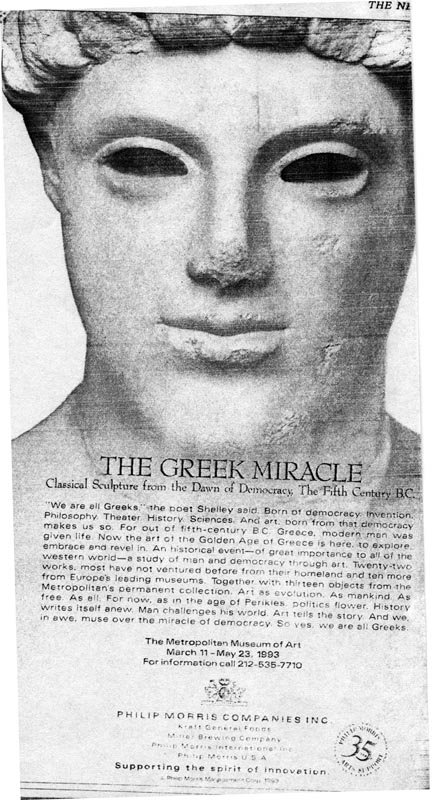 This ad appeared in 1993 in The New York Times. It celebrated the opening of a major exhibition entitled The Greek Miracle at the Metropolitan Museum of Art. The head is from a statue known as the Kritios Boy. This work was made about 480 BCE, and is seen to mark the break between the Archaic and Early Classical periods of Greek art. Read the text accompanying the ad and respond to it in your journal.
Tuesday, February 25: bring in a draft of your Second Paper Assignment.
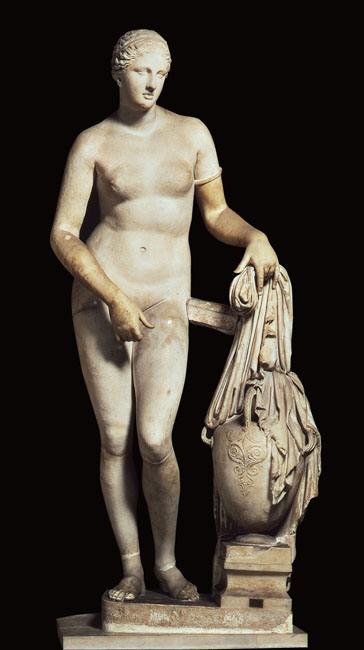
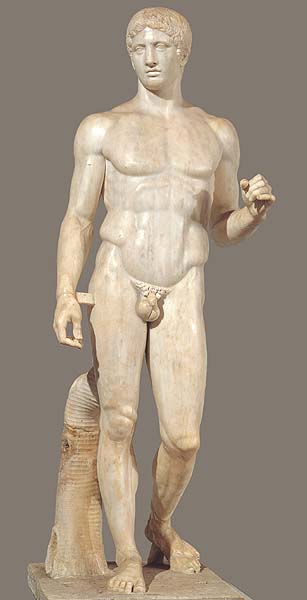
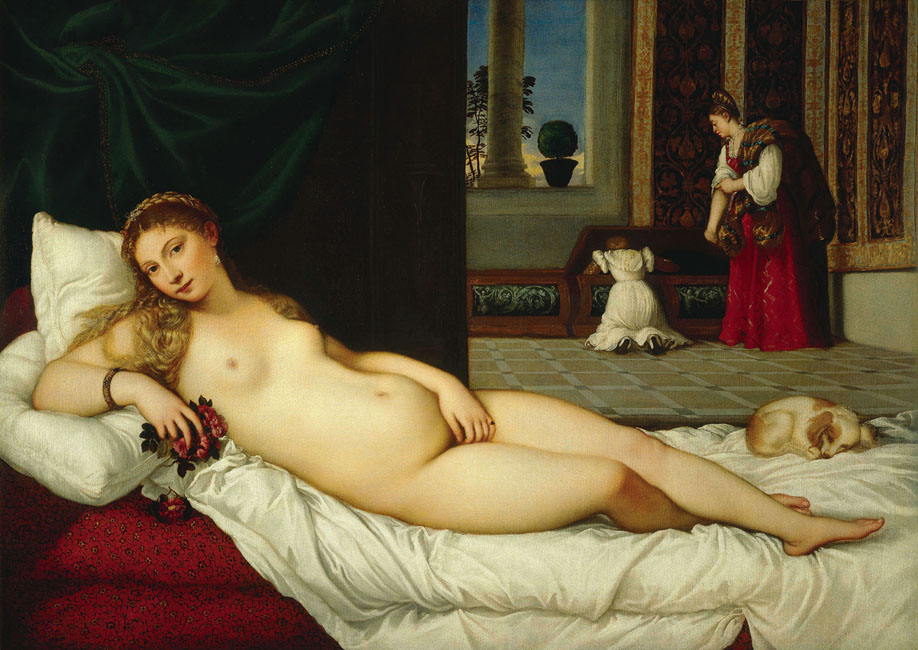
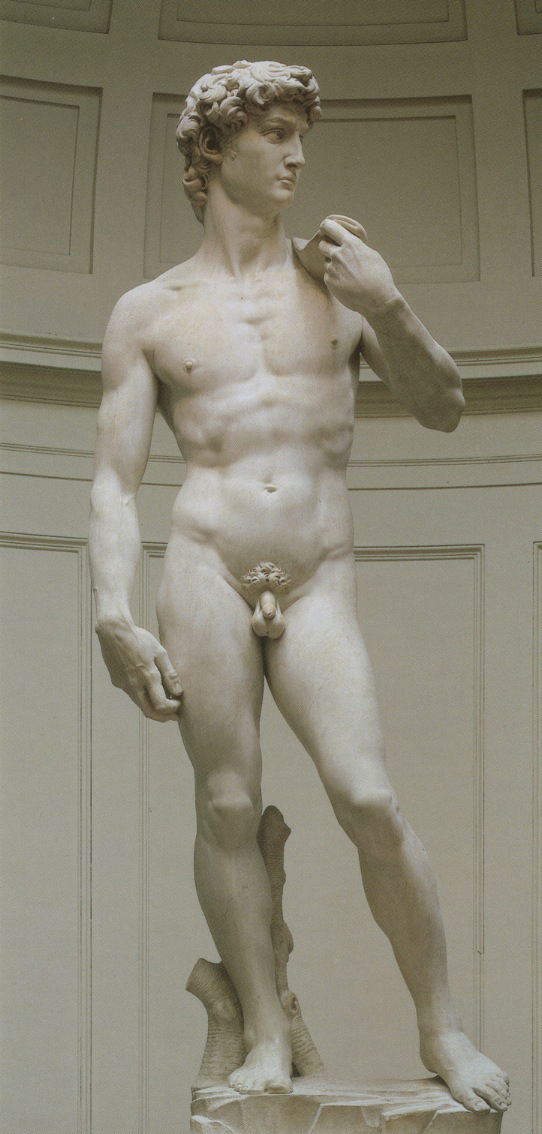
We will return to our discussion of gender construction in Greek art. A pivotal moment occurred in the 4th century BCE which saw the creation by the artist Praxiteles of his Aphrodite of Knidos. This can be understood to be the first monumental nude female sculpture in Greek art. Read the excerpts included on the webpage entitled The Aphrodite of Knidos and the Invention of the Female Nude in Greek Art. Compare and contrast the conception of the nude female to the nude male figure illustrated by the following comparison:
Roman copy of Praxiteles, Aphrodite of Knidos, c. 330 BCE |
Roman copy of Polykleitos, Doryphoros, c. 440 BCE. |
Titian, Venus of Urbino, finished 1538. |
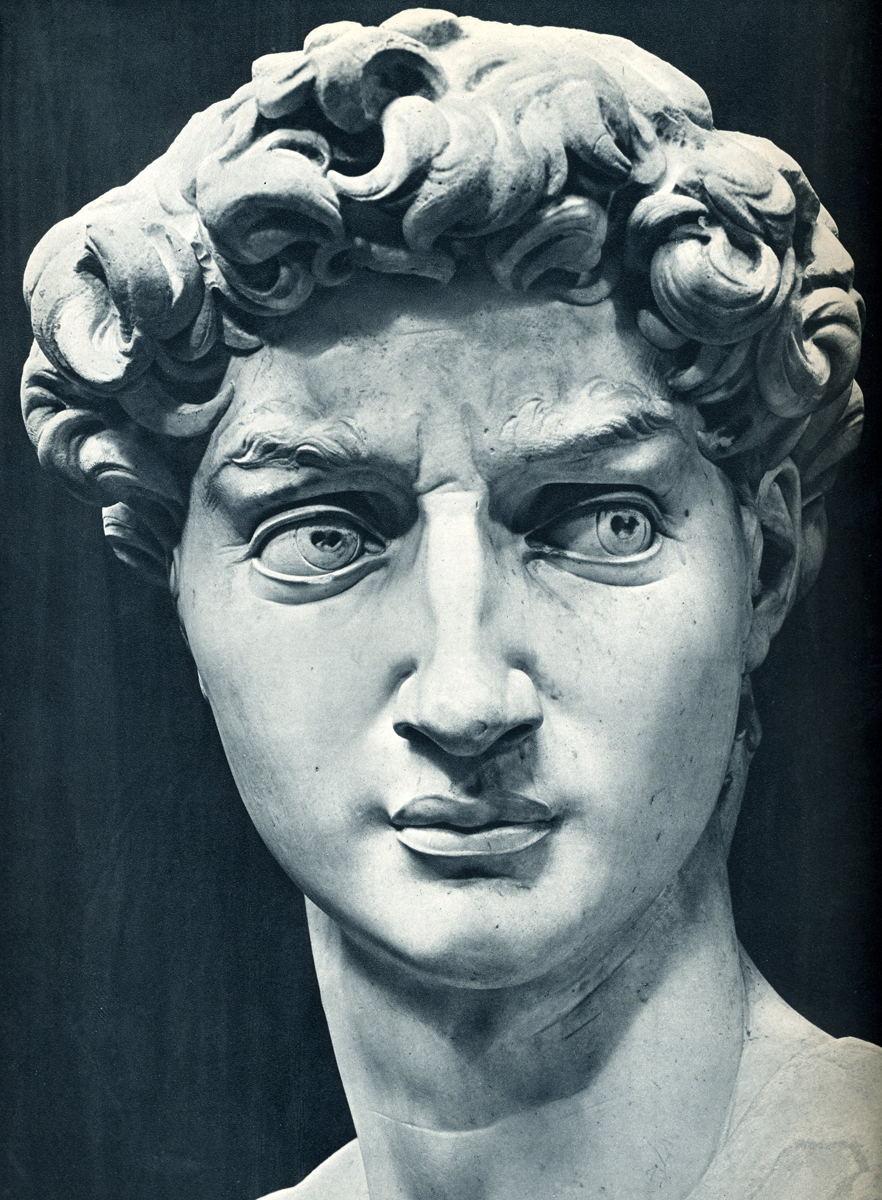
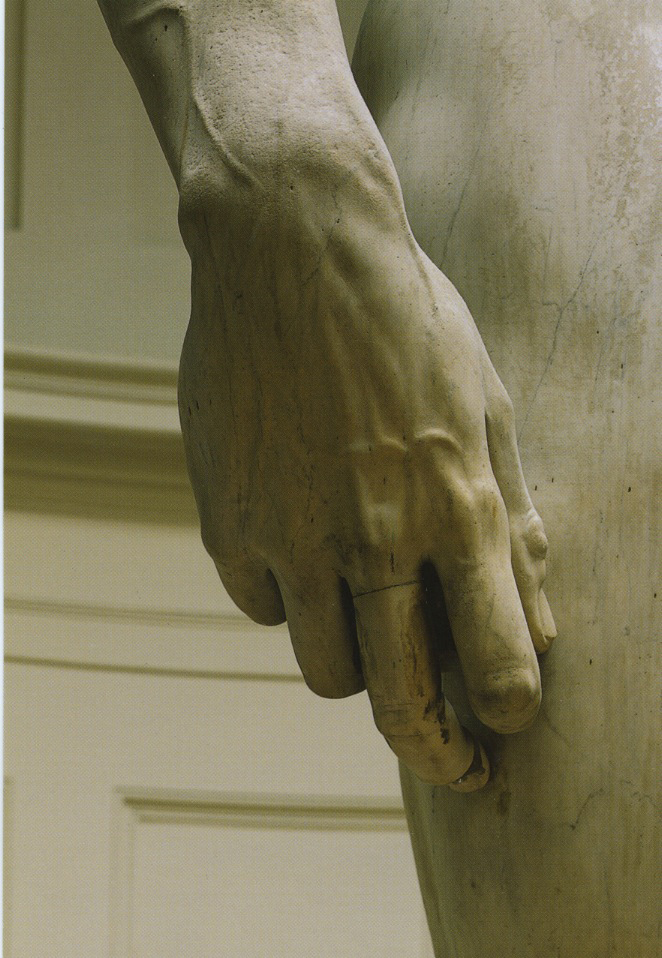
Michelangelo, David, 1501-04.
|
|
 |
 |
|
Thursday, February 27: Deadline for submitting your Second Paper Assignment.
I want to turn to a consideration of late Medieval and Renaissance culture. I want to apply the idea of reading images from the perspective social codes to an important monument of early fifteenth century French culture, the Trés riches heures. On the linked page you will find a discussion of several of the calendar illustrations in this manuscript. For our purposes I want to pay particular attention to the January, February, April, and May images. Look at these images from the perspective of social codes. Pay attention particularly to the question of gender and social class.
Thursday, March 6: Any consideration of Northern Renaissance art needs to take into consideration Jan Van Eyck's so-called Arnolfini Wedding Portrait. While scholars debate about whether this is a wedding portrait or not, there is no question that the relationship of the man (Giovanni Arnolfini, an Italian merchant active in the Netherlands) and woman (Giovanna Cenami, a daughter of prominent, Italian merchant family also active in Northern Europe) is central to the content of the painting. Review the webpage I have created for the Arnolfini Wedding Portrait. A significant issue in the painting is the question of the social role of women and marriage as an institution in the fifteenth century. To give you some historical context read the page entitled Women in Renaissance Florence. For more information on the social standing of Jan Van Eyck, review the page focused on Van Eyck as a Court Painter that I have developed for my Northern Renaissance Art class.
Tuesday, March 11: continuation of our discussion of the Arnolfini Wedding Portrait.
Thursday, March 13: We will shift our focus from northern Europe to Italy. I want to explore the gender construction of Leonardo da Vinci's Mona Lisa, but to do this it is important to understand the social and artistic contexts for the painting in order to appreciate the innovations in Leonardo's painting. Today's class will examine these contexts. Read the excerpts from the essay by Dale Kent "Women in Renaissance Florence" which is included in the exhibition catalog entitled: Virtue and Beauty. Also read the excerpts from Patricia Simons's article "Women in Frames: The Gaze, the Eye, the Profile in Renaissance Portraiture."
Tuesday, March 18: Deadline for submitting ideas for topics for the Third Paper Assignment.
No survey of western art since the Renaissance can ignore an examination of Leonardo da Vinci's Mona Lisa. In the context of our discussion of the construction of gender in art, this painting can also claim a central place. To give a recent critical perspective on Leonardo's Mona Lisa, read the excerpts from Mary Garrard's article "Leonardo da Vinci: Female Portraits, Female Nature." See also the page I have entitled Mona Lisa and her Sisters.
Thursday, March 20: We will continue our discussion of images of women in Italian Renaissance art, by examining the development of the female nude. We will focus in particular on the Venetian artist, Titian's Venus of Urbino. Although not the first female nude in the Renaissance, this work has come to play a central role in the development of this category of art. I have prepared a webpage on the Venus of Urbino which includes some of the recent scholarly responses to this work. In reviewing this material pay attention to the connections you notice to the material included in the earlier material we have discussed.
Tuesday, March 25: We will discuss two of the statues of David in Florentine art: Michelangelo's David of 1501-1504 and Donatello's David from before 1469. You can use the images above of the Michelangelo. For the Donatello consider the web page I have created for the work: Donatello's David. To provide a different context for the Donatello, consider the following Susan Bordo, The Male Body.
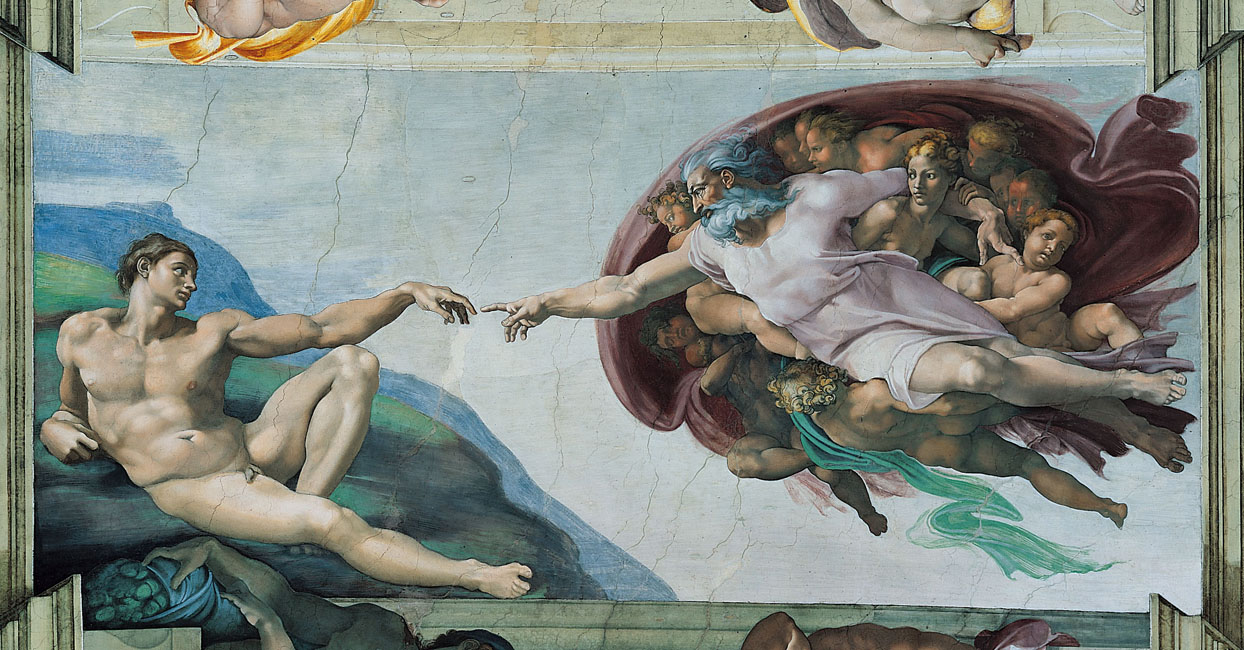
Tuesday, April 8: Read the webpage entitled Albrecht Dürer: Artist Drawing a Nude . Also consider the page dedicated to an illustration of Amerigo Vespucci Discovering America. In this discussion, I also want to introduce Michelangelo's Creation of Adam from the Sistine Ceiling:
Thursday, April 10: bring in a draft of your Third Paper Assignment to be workshopped.
I want to follow up on our discussion of the Dürer illustration of the Artist Drawing the Nude by considering a comparison between European and Chinese attitudes landscape painting. Consider the page entitled Comparison between East and West. Be advised that I have explicitly asked you to record responses to several questions in your journals. I am going to expect you to be willing to share your responses in class.
Hayden / Feinstein Hayden Feinstein
Tuesday, April 15: deadline for submitting Third Paper Assignment.
Examination of any of the traditional surveys of Western Art reveals that a good number of the "masterpieces" of sixteenth and seventeenth century art focus on the subject of rape. In a web-page entitled Authoritative and Disciplined Discussions of Masterpieces, I have included excerpts from some of these surveys discussing some of these images of rape. Read these texts and consider how the art historian deals with or does not deal with the subject of rape. These images have been reexamined from a feminist perspective. Read the excerpt from the article by Margaret D. Carroll entitled "The Erotics of Absolutism: Rubens and the Mystification of Sexual Violence" and from the book by Diane Wolfthal entitled Images of Rape: the "Heroic" Tradition and its Alternatives. I realize that this assignment entails a fair amount of reading, but I remind you that the success of our discussion depends on your careful reading and consideration of this material. My intention is to both become aware of a particular category of subject matter in western art and to critically examine how traditional art history has approached this subject.
Thursday, April 17: I want to consider the work of probably the most significant female artist of the seventeenth century, Artemisia Gentilleschi. The daughter of a painter, Orazio Gentilleschi, Artemisia's works present an interesting alternative point of view. Some of her major works focus on female heroes. She especially focused on the Old Testament female figures like Susannah and Judith. These works are illustrated on the linked web page. I have compared Artemisia's paintings to those of dominant male artists. In the case of the story of Susannah and the Elders, I have included the Biblical text that is the source of the images. Read the text carefully and consider how the artists represent these texts. Also consider how Artemisia constructs her female protagonists.
Tuesday, April 22: We will consider gender construction in 18th century French art. This century began with the period we call the Rococo and ended with Neo-Classicism. French Rococo art is exemplified by the paintings of Antoine Watteau (see the slide list for my ARTH 110 course for examples of Watteau's work). One of the most famous Rococo images is that by Jean Honoré Fragonard entitled the Happy Accidents of the Swing. Read the excerpt from a textbook account of The Swing. The attitudes expressed in Watteau's and Fragonard's art are in marked contrast to that of Neo-Classicism as exemplified by Jacques Louis David's famous painting The Oath of the Horatii of 1784-85:
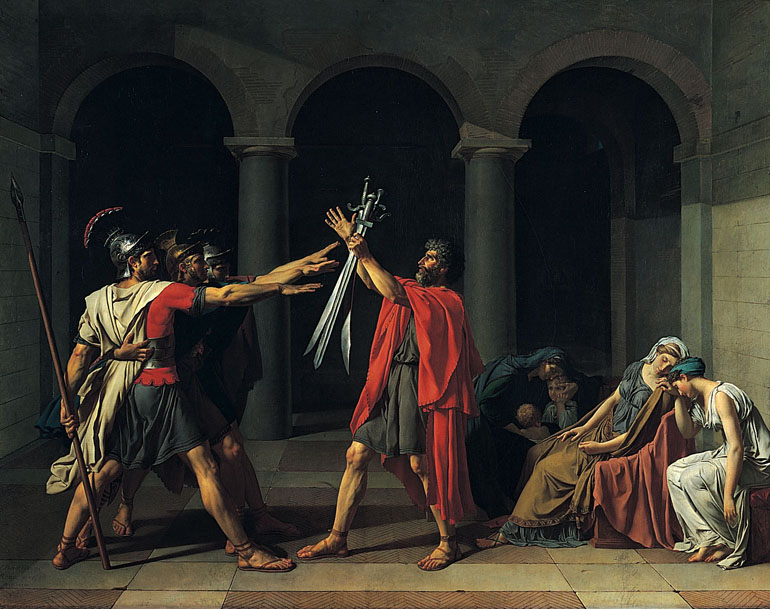
Do a gender reading of David's painting. Pay careful attention to the binary oppositions employed to distinguish male and female. To give you a context for understanding David's painting read the excerpt discussing the painting and the art of the salon.
Thursday, April 24: We will turn to an examination of nineteenth century art. I have prepared a gallery of examples of Nineteenth-Century Images of Women. Review these images. Select three of these, and outline your gender reading of these images in your journal. Horse/Power
Tuesday, April 29: I want you to challenge yourself to read excerpts from Griselda Pollock's influential article entitled "Modernity and the Spaces of Femininity" in which she draws the contrast between male and female social spaces in nineteenth century Paris and the contrast between the approaches between male and female artists. This is not a text written for an introductory audience, but from your experience in this course, it should be more accessible. See the web page I have created examining Social Spaces in nineteenth century Paris.
Thursday, May 1: There will be no formal class today. You are invited to attend the Art History conference in Hamblin Theater. I am doing a presentation about 9:00.
Tuesday, May 7: Bring in a draft of your Final Paper to workshop. I want to consider one of the major artistic statements of Modern Art, Pablo Picasso's Les Demoiselles d'Avignon. I want to examine it in the context it plays in the narratives of the development of Modern Art. This narrative is made manifest not just in the art historical discussions, but in the lay-out of museums. Read the excerpts from Carol Duncan's essay entitled "The MoMA's Hot Mamas." This essay makes explicit the central role the female body has played in the development of Modern Art.
Tuesday, May 13, 9:00-10:30 (note the time change): Final Meeting Time and Deadline for Submitting Journals and Writing Portfolios. Include in your Writing Portfolio your Final Paper.